Commercial Visions: An Interview

Dániel Margócsy’s beautiful new book explores the changing world of entrepreneurial science in the early modern Netherlands. Commercial Visions considers scientific knowledge as a commodity, looking carefully at how the growth of global trade in the Dutch Golden Age shaped anatomy and natural history as commercial practices. We had a chance to talk about it recently for the New Books in STS podcast, and you can find our conversation … Continue reading Commercial Visions: An Interview

The Elements of Academic Style: An Interview

Every academic-writing person should own a copy of Eric Hayot’s new book. The Elements of Academic Style is a style guide geared specifically toward academic writers in the humanities, paying special attention to the field of literary and cultural theory but applying equally well across humanistic disciplines. It’s fabulous, Eric generously made time to talk with me about it for the New Books Network Seminar, and you can … Continue reading The Elements of Academic Style: An Interview

Public Memory in Early China: An Interview

Ken Brashier’s wonderful new book, a must-read for scholars of Chinese studies, offers a history of identity and public memory in early China. We had a chance to talk about it for the New Books in East Asian Studies podcast, it was a lot of fun, and you can listen to the interview here. (Ken and I also talked about his previous – and also awesome – book … Continue reading Public Memory in Early China: An Interview

Bad Water: An Interview

Robert Stoltz’s fascinating book Bad Water explores the emergence of an environmental turn in modern Japan, guiding readers through the unfolding of successive eco-historical periods in Japan while charting the transformations of an “environmental unconscious” lying at the foundation of modern social and political thought. Robert and I had a chance to talk about it for the New Books in East Asian Studies podcast, and you can listen to our conversation here. Continue reading Bad Water: An Interview

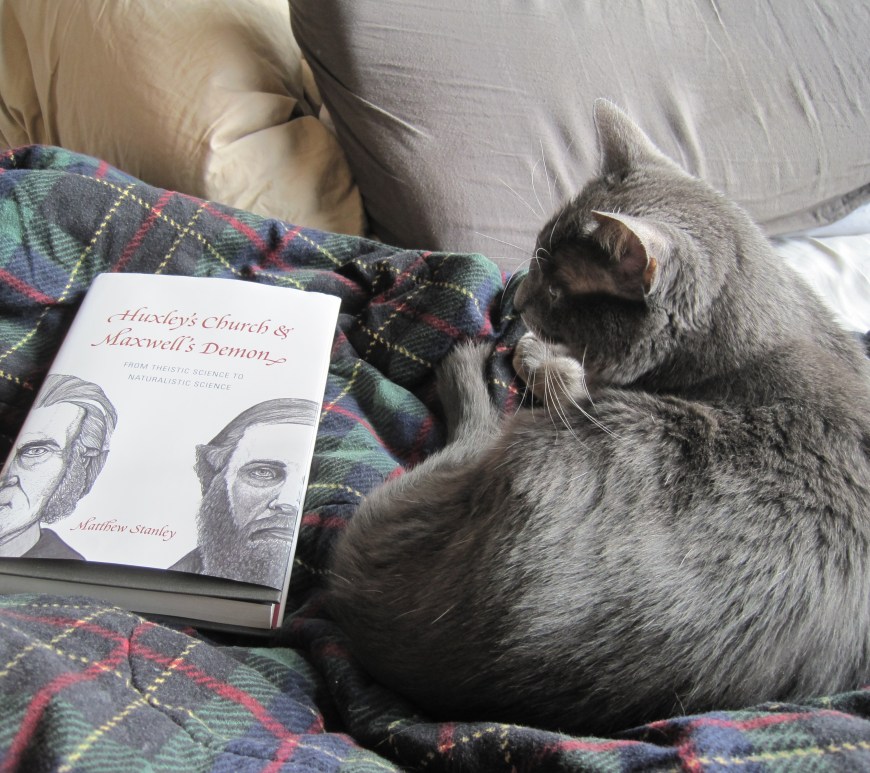
Huxley’s Church and Maxwell’s Demon: An Interview

Matthew Stanley’s wonderful new book introduces James Clerk Maxwell (1831-79) and T.H. Huxley (1825-95) as they embodied theistic and naturalistic science, respectively, in Victorian Britain. Moving well beyond the widespread assumption that modern science and religion are and always have been fundamentally antithetical to one another, Huxley’s Church and Maxwell’s Demon offers a history of scientific naturalism that illustrates the deep and fundamental commonalities between positions on the proper practice … Continue reading Huxley’s Church and Maxwell’s Demon: An Interview

Modern Archaics: An Interview

I recently had the opportunity to talk with Shengqing Wu about her new book on practices and discourses of classical poetry in early twentieth-century China. Modern Archaics considers the relationship between history and lyricism in contexts of (1) historical trauma and loss; (2) the development of affective communities that treated lyric composition as an integral part of shared social practice; and (3) travel and translation.  It’s a … Continue reading Modern Archaics: An Interview

Working Paper – “Paper Dolls: An Architectonics of Translation in Early Modern Eurasia”

Last week I was fortunate enough to participate in a session of the Sawyer Seminar on Critical Silk Road Studies at Georgetown organized by the wonderful Jim Millward and Michelle Wang. The seminars take the form of discussions (catered this time with delicious wine, dinnerfood, and cupcakes) of pre-circulated papers, prefaced by brief introductions by the authors (in this case, Pierce Salguero and me) and a commentary … Continue reading Working Paper – “Paper Dolls: An Architectonics of Translation in Early Modern Eurasia”

Translating Recipes 8: Recipes in Time and Space Part 2 – WITH

The second part of a multi-part series exploring time and space in (Manchu) recipe literature and in translation has just been posted at The Recipes Project. You can find it here. This one focuses on drawing our attention to “with”-ness. Later posts in this series will take on other prepositional attitudes that situate bodies with respect to one another in time and space: on, in, toward, etc. The … Continue reading Translating Recipes 8: Recipes in Time and Space Part 2 – WITH